
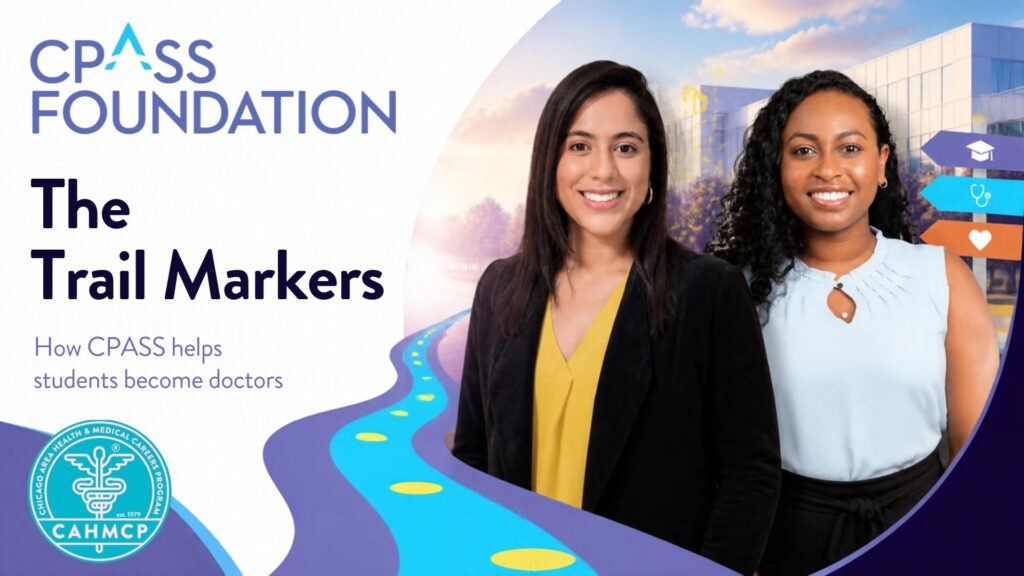
Ruth Lodoño Alzate and Jhada Black both knew they wanted to pursue careers in medicine from an early age. But as young girls from immigrant families, they didn’t know what that path would look like and what kind of help would be needed to make it to the trail head. For both women, focus, determination, and wisdom from their communities paid off: They are currently doing clinical rotations at Chicago-area hospitals while finishing up medical school.
Ruth’s first steps toward healthcare
When Ruth was growing up in Columbia, she suffered from a severe ear infection and was finally helped by an exam and antibiotics at a free clinic. She was so grateful to be rid of the pain, she decided she wanted to help people just like the professionals at the free clinic had helped her.
“I wanted to do that too – to have the knowledge needed to help people who are in pain or struggling with their health,” she said.
When Ruth was 12, her family emigrated to the United States, settling in a far-north working-class suburb of Chicago near Waukegan. From there she attended University of Illinois at Champaign-Urbana for her undergraduate, where she was introduced to social justice advocacy in her Latinx co-ed fraternity around the same time she began to experience prejudice as a Latina in STEM.
“I became more aware I was being judged based on my ethnicity rather than my actual abilities. It seemed like just a little discrimination that I felt here and there, but before then I didn’t truly see what was happening,” Ruth said. “For example, there was a person in my group in organic chemistry who didn’t want to work with me because I am Latina.
These experiences, framed by her newfound passion for social justice, led her to learn more about social determinants of health and develop a deeper understanding of how her immigrant community in the Waukegan area was being marginalized.
“It ignited something in me, which grew into also wanting to help other marginalized communities,” she said.
She studied abroad in Senegal, where she learned French and developed a passion for alleviating the suffering of Black communities.
She said, “I learned about historical injustices dating back from the slave trade and saw firsthand how they still affect people today.”
When Ruth graduated from University of Illinois, she joined the Peace Corps, which placed her in Guatemala working in the Healthy Schools program. There, she not just taught children the essentials of health promotion like tooth brushing and hand-washing, she developed lesson plans on health for teachers and helped build infrastructure like water systems, toilets, and kitchens to support well-being.
Ruth’s next steps: Work, then PMP and medical school
When Ruth returned from the Peace Corps, she worked as a medical assistant/scribe while she studied for the MCATs. A mentor at work warned her she needed at least a 500 before she could apply to medical schools. The fear that put into her helped her earn the score she needed to be accepted into the Rosalind Franklin University pre-matriculation program that led right into medical school.
Ruth loved medical school from the start and got involved in extra-curricular activities including a community health fellowship and providing blood pressure screenings at a local black-owned store.
She also discovered her interest in medical interpretation. As a native Spanish speaker who also speaks French, she worked as an interpreter at Rosalind Franklin’s free clinics.
“It was very exciting because it showed me how strong the need for interpretation is,” she said. “Healthcare is a partnership, and if you can’t understand, you can’t participate.”
Ruth developed her leadership skills as the executive officer for interpreter services and as the co-president of the Latino medical student organization.
She learned about the CPASS Foundation from the office of diversity and inclusion at school around the same time she realized her STEP 1 practice exam scores weren’t where she wanted them to be. CPASS funded her enrollment in Kaplan test-prep classes. Ruth found it hard to make the time to learn test-prep and to find a tutor who left her feeling encouraged. Eventually, she found both and did well on her exam.
Today, she is doing clinical rotations at Advocate Lutheran General Hospital in Park Ridge and taking more Kaplan test-prep through CPASS ahead of her STEP 2 exams. She plans to stay connected with CPASS and use all the help it can give her as she finishes medical school and begins residency with a goal of a career in psychiatry or family medicine.
Jhada’s detours along her path
Jhada Black’s interest in medicine was piqued as a child by a book she read about midwives in the 1800s. That idea stuck, and she doesn’t remember ever having a different career goal beyond being an OB/GYN.
Like Ruth, Jhada is from an immigrant family. She came to the U.S. from Jamaica when she was 5 or 6 years old, settling in Southeast Florida. Jhada got her pre-med undergraduate degree from the University of Chicago and wanted to stay in the Chicago area for medical school, where she had built a foundation.
However, the Covid pandemic changed her carefully crafted plans. So to help prepare herself for medical school, Jhada decided to first earn a master’s degree in biomedical science at University of Miami. This kept her closer to her family in Florida while the pandemic raged on. She then took a year to apply to medical schools while working as a medical assistant at a family practitioner’s office and living at home.
“Although I had a very solid educational background, when I began applying to medical school I realized I didn’t know how to be a compelling candidate,” Jhada said. “I later learned about organizations like CPASS that are actively creating support for minorities. My experience would have been a lot easier if I knew about these resources earlier. There’s a lot you don’t know.”
Jhada’s trail takes more turns
After a personal journey she described as “tumultuous,” Jhada moved back to Chicago to attend medical school at Rush Medical College. At Rush, she gained a mentor in the late Sharon Gates from the community service initiatives program. This opened the door to volunteering and acts of service.
Jhada volunteered with the mini-med program at Rush Medical College, introducing school-aged children to careers in health, science, and other STEM fields. That was her introduction to what CPASS had to offer to students of all ages. She has since used CPASS funding for help with STEP 1 fees and has received a scholarship for STEP 2 test prep.
During medical school, Jhada encountered more “bumps in the road” but remained committed. When health problems and the loss of a family member kept her from performing at the high level she expected from herself, she took a year off.
“It was so hard seeing my classmates move on when I couldn’t. I was disappointed I couldn’t compartmentalize my personal difficulties,” she said.
“I had to learn that I couldn’t be compassionate toward patients if I’m not compassionate toward myself. I came to understand that we are not machines that keep turning,” she continued. “Forcing myself to take time to grieve and recovered humbled me.”
Today, Jhada is back at it. She’s finding that being exposed to other specialties in her rotations at Rush University Medical Center are opening her up to options besides OB/GYN.
“Sometimes I joke with my classmates, ‘Oops! I’m becoming a neurologist!’” she said. “I go where God leads me, so I’ll keep an open mind. But on the other hand, residency is a commitment, so that decision requires a lot of self-reflection.”
She’s open about the toll combining the full-time job of rotations and the full-time job of medical school takes, especially for someone like her with a chronic condition that causes fatigue. Although she sometimes grapples with studying all evening after a long day at the hospital, she knows that in the end, it will all be worth it.
Advice from tomorrow’s doctors
Jhada admits that her journey was more difficult than it had to be because she didn’t reach out for help sooner.
“I’ve climbed some mountains and fallen down some valleys because I didn’t see the trail markers already put in place by others. I want to pay forward the knowledge that people from minority backgrounds usually want to pull others up,” she said. “With any dream you need to work hard and have discipline. But you also need community, peers, and mentors.”
Ruth’s echoes that sentiment. Her advice for other minorities considering careers in medicine is,
“Don’t give up! Keep trying, even if the road gets rough. Also, get help when you need it.”
Jhada stresses that a career in medicine is possible for anyone who wants it.
“I don’t want anyone to be intimidated by the elitism around the MD. It doesn’t matter what your background is because the people you find at medical school are not any different than you,” she says. “You will encounter barriers, but that’s why foundations like CPASS are more vital than ever – to help minorities overcome them. There is space for you, and medicine will be better with more people who look like you.”